
What is free flap reconstruction?
Microvascular free flap reconstruction rebuilds areas of the head and neck after tumor removal by transferring living tissue, with its own blood vessels, from another part of the body, such as the forearm, thigh, or lower leg. The vessels are reconnected under magnification to restore blood supply. The goal is to restore both form (appearance) and function (speech, swallowing, chewing) after cancer surgery.
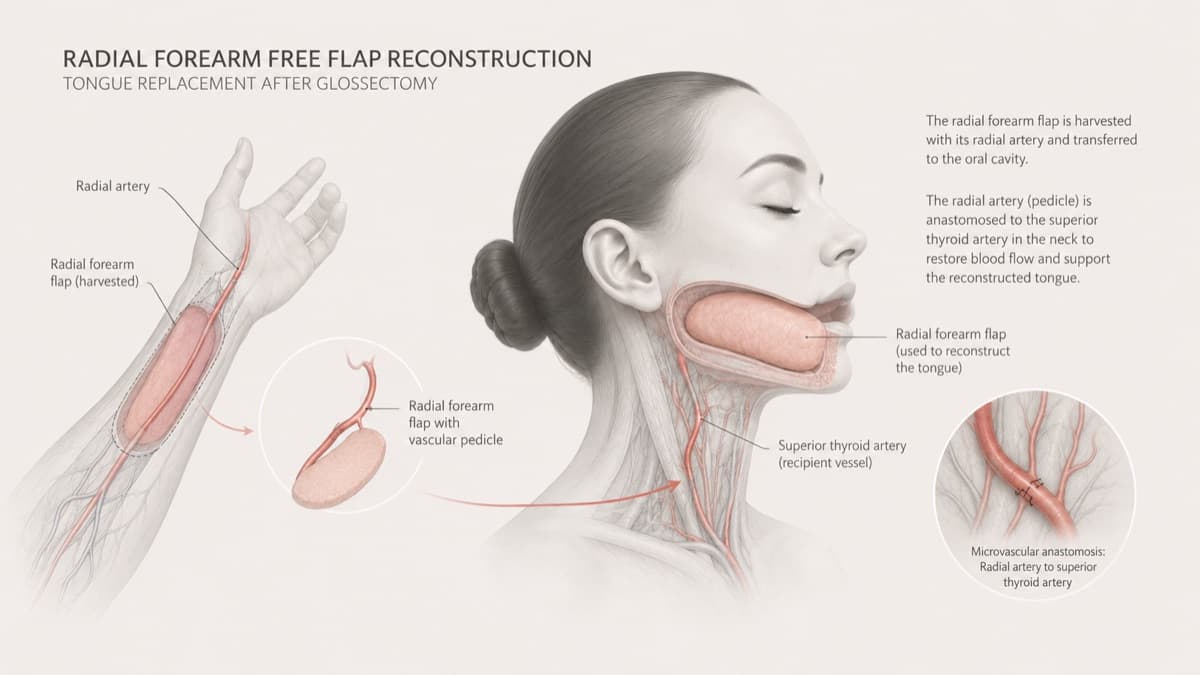
When a head and neck cancer is removed, it can leave a defect in the tongue, cheek, palate, or jaw that affects how a person looks, speaks, eats, or swallows. A free flap is a piece of the patient's own tissue (skin, muscle, or bone, along with its blood vessels) moved from a donor site to rebuild that area. Because it comes with its own vessels, the surgeon reconnects those vessels to vessels in the neck under a microscope, so the transferred tissue stays alive and heals.
This is among the most technically demanding reconstructive surgery, and it is what makes it possible to remove a cancer completely while still restoring a good quality of life.
Medically reviewed by Jennifer Almelor-Alzaga, MD, board-certified Otolaryngologist (PSO-HNS), fellowship-trained in Head & Neck Oncologic Surgery and Microvascular Free Flap Reconstruction. Last reviewed: October 3, 2026.
When is reconstruction needed?
Free flap reconstruction is considered when head and neck cancer surgery leaves a defect that needs rebuilding, for example:
- ✓After removing a large tongue or floor-of-mouth tumor (to restore speech and swallowing)
- ✓After removing part of the jawbone (rebuilt with bone, often from the fibula)
- ✓After removing tumors of the cheek, palate, or other facial structures
- ✓When a defect is too large to close directly or with simpler techniques
What to expect
At a Glance
- Purpose
- Rebuild after head & neck tumor removal
- Tissue from
- Forearm, thigh, or lower leg (fibula)
- Technique
- Microsurgery: vessels reconnected under magnification
- Anesthesia
- General
- Where
- Philippine General HospitalManila Doctors HospitalMakati Medical Center
Risks & What to Discuss with Your Surgeon
Free flap surgery is complex, and the central concern is the blood supply to the transferred tissue, which is why the flap is monitored intensively early on; occasionally a return to surgery is needed to protect it. There is also healing to consider at both the reconstructed area and the donor site. These operations are best done by surgeons with dedicated microvascular training. Your surgeon will explain the specific risks, the donor site chosen, and the expected functional outcome for your case.
Why choose Dr. Alzaga for reconstruction
This is Dr. Jennifer Almelor-Alzaga's rarest and most specialized credential. She completed a dedicated fellowship in microvascular free flap reconstruction (Thailand, 2018–19) on top of her head and neck oncologic surgery training (Taiwan). Few surgeons in the Philippines can both remove a head and neck cancer and perform the microvascular reconstruction to rebuild it. Having one surgeon lead both stages supports a smoother, more coordinated plan.

Jennifer Almelor-Alzaga, MD, FPSOHNS
Board-certified Otolaryngologist–Head & Neck Surgeon. Fellowship-trained in Head & Neck Oncologic Surgery (Taiwan) and Microvascular Reconstruction (Thailand).
Ready to book a consultation?
Choose your preferred clinic location below. Appointments are required — no walk-ins.
Cash or bank transfer accepted. We do not accept HMOs, GCash, or credit cards. Appointments are strictly required. No walk-ins.
Frequently Asked Questions
Related procedures
This page is for general information only and does not constitute medical advice, diagnosis, or a treatment plan. Individual cases vary — always consult a qualified medical professional for advice specific to your situation. Dr. Jennifer Almelor-Alzaga, MD is available for consultations at Makati Medical Center and Olistico Health Manila.